President Bola Ahmed Tinubu’s preparations for the 2027 presidential election have sparked fresh political debate following the inclusion of promine
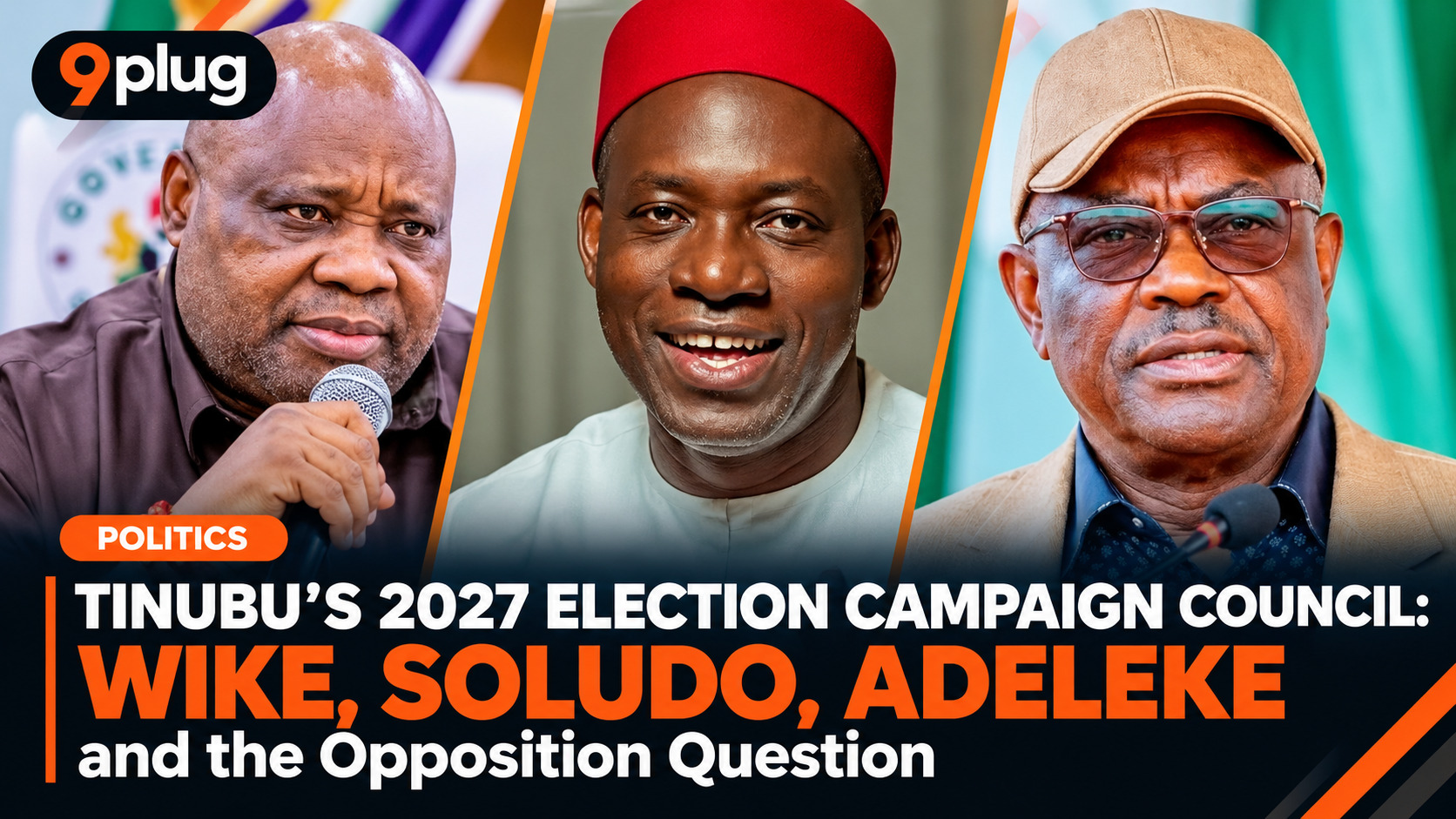
President Bola Ahmed Tinubu’s preparations for the 2027 presidential election have sparked fresh political debate following the inclusion of prominent politicians from opposition parties in the All Progressives Congress (APC) Presidential Campaign Council.
Among the notable names are Federal Capital Territory (FCT) Minister Nyesom Wike, Osun State Governor Ademola Adeleke and Anambra State Governor Chukwuma Soludo. Their appointments have raised questions about party loyalty, political alliances and the role of opposition parties in Nigeria’s evolving political landscape.
The revised campaign council list, reported in October 2026, places the three politicians in coordinating roles for Tinubu’s re-election campaign in their respective territories. The development has generated debate among political stakeholders, with supporters describing it as cross-party cooperation and critics questioning its implications for Nigeria’s multiparty democracy.
Wike, Soludo and Adeleke Take Key Campaign Roles
According to reports on the revised APC campaign council, Wike is assigned responsibility for coordinating Tinubu’s campaign in Rivers State and the Federal Capital Territory. Soludo is to coordinate campaign activities in Anambra State, while Adeleke has been assigned the Osun State campaign.
The appointments are significant because the three politicians maintain affiliations with parties other than the APC.
Wike remains associated with the Peoples Democratic Party (PDP), Soludo belongs to the All Progressives Grand Alliance (APGA), and Adeleke was elected governor of Osun State on the platform of the Accord Party.
Their participation illustrates how Tinubu’s campaign is seeking support beyond the traditional membership of the ruling party.
However, the appointments do not automatically mean that the three politicians have defected to the APC or that their respective parties have merged with the ruling party.
Why Tinubu’s Campaign Is Attracting Opposition Figures
The inclusion of politicians from different parties reflects the APC’s effort to build a broad political coalition ahead of the 2027 general elections.
Supporters of the arrangement argue that political cooperation across party lines can expand the president’s support base and strengthen campaign mobilisation at the state level.
Wike has defended the broader cross-party initiative, describing it as a coalition intended to unite supporters of Tinubu rather than undermine the APC’s existing structure.
The approach could allow the president’s campaign to draw on the influence, political networks and local experience of prominent figures outside the ruling party.
Nevertheless, the arrangement raises questions about how campaign responsibilities will be shared between the appointed coordinators and established APC structures in their respective states.
It also remains to be seen how the alliance will translate into electoral support when the 2027 campaigns intensify.
The Opposition Questions Party Loyalty
The appointments have attracted criticism from opposition figures who argue that politicians holding leadership positions in opposition parties should explain their participation in the ruling party’s presidential campaign.
One of the most prominent critics is Paul Ibe, media adviser to former Vice-President Atiku Abubakar. In an opinion article published by TheCable on October 16, 2026, Ibe questioned whether politicians could retain membership of opposition parties while formally coordinating the re-election campaign of the APC presidential candidate.
His argument centres on the distinction between cooperating with a government on public policy and taking an active organisational role in securing the electoral victory of a rival party.
The debate raises important questions about political accountability, party discipline and the expectations voters have of elected officials.
However, cross-party political support does not, by itself, establish that a politician has violated a party constitution. Determining whether any rules have been breached would require examining the relevant party constitutions, internal authorisations and applicable legal provisions.
Adeleke’s Position Raises Additional Questions
Adeleke’s appointment has attracted particular attention because Accord has its own presidential nomination for the 2027 election.
Reports published in October 2026 said a Federal High Court in Abuja ordered Accord and the Independent National Electoral Commission (INEC) to recognise Gbenga Olawepo-Hashim as the party’s presidential candidate. The judgement was subsequently challenged on appeal, according to published reports.
This development has added another dimension to the debate over Adeleke’s decision to coordinate Tinubu’s re-election campaign in Osun State.
Some Accord officials have supported the governor’s political position, while critics have questioned how his campaign responsibilities relate to the party’s own presidential ambitions.
The legal dispute and the political endorsement are separate matters. The status of the court judgement, the outcome of any appeal and the formal decisions of Accord’s authorised organs are relevant to understanding the party’s position.
The controversy therefore extends beyond Adeleke’s personal political preference to questions about how political parties make decisions and communicate their electoral objectives to members and voters.
What Does Soludo’s Appointment Mean for APGA?
Soludo’s inclusion in the campaign council also raises questions about the relationship between individual political endorsements and formal party positions.
The Anambra governor won a second term in 2025 under APGA. His appointment as Tinubu’s campaign coordinator in the state places him in a position to support a presidential candidate from another political party.
Supporters may view this as an example of political cooperation that crosses traditional party boundaries. Critics, however, may ask whether such arrangements affect APGA’s ability to present a distinct political position in the presidential election.
The key issue is whether Soludo’s participation represents an individual political decision, an authorised party arrangement or a broader agreement between political interests.
Without clear evidence of a formal party decision, his appointment should not be treated as proof that APGA has adopted Tinubu as its presidential candidate.
Wike’s Role and the PDP’s Internal Challenges
Wike’s appointment adds to the longstanding debate over his relationship with the PDP and the Tinubu administration.
Since becoming FCT minister under the APC-led federal government, Wike has remained a prominent figure in discussions about the PDP’s internal divisions and political direction.
His new campaign responsibility takes the relationship further by placing him within the organisational structure of Tinubu’s re-election effort.
Critics argue that the arrangement raises questions about the distinction between belonging to an opposition party and actively campaigning for the ruling party’s presidential candidate.
Supporters of cross-party cooperation, on the other hand, may argue that political alliances are a legitimate feature of democratic competition.
The implications for the PDP will depend partly on its internal response, the rules governing members’ political activities and whether the party clarifies the scope of any authorisation given to Wike.
APC Members Also Face Questions
The controversy is not limited to opposition parties. The inclusion of non-APC politicians has reportedly attracted objections from some ruling-party members who question why prominent figures outside the party have been assigned campaign responsibilities.
Such concerns reflect the challenge of balancing the desire to broaden a presidential campaign’s support base with the interests of longstanding party members.
For the APC, the expanded council could provide access to wider political networks. At the same time, party leaders must manage expectations among members who want established party structures to remain central to campaign planning and mobilisation.
How these competing interests are handled may influence the effectiveness of the campaign organisation as the election approaches.
What the Campaign Council Means for the 2027 Election
The expanded campaign council is part of the APC’s preparations for the 2027 presidential election. Its members are expected to help coordinate political outreach, mobilisation and campaign activities across the country.
The appointments also highlight the importance of state-level political networks in Nigeria’s presidential contests.
Rivers, Anambra and Osun each have distinct political dynamics, making the responsibilities assigned to Wike, Soludo and Adeleke significant for the campaign’s regional strategy.
However, an appointment alone does not guarantee electoral success. The campaign’s impact will depend on voter engagement, the candidates’ policy positions, public assessment of the administration’s record and the ability of political organisations to mobilise support.
Opposition parties will also have to decide how to respond, whether by strengthening their internal structures, forming alliances or presenting alternative policy programmes.
The Bigger Question: Who Really Represents the Opposition?
The controversy surrounding Tinubu’s campaign council highlights a wider question about the meaning of opposition politics in Nigeria.
Political parties are expected to offer voters identifiable choices, competing programmes and candidates capable of challenging the ruling party at the ballot box. When prominent opposition figures take formal roles in the incumbent president’s re-election campaign, voters may reasonably seek clarification about their political commitments.
At the same time, democratic politics allows individuals and parties to negotiate alliances, endorse candidates and cooperate across party boundaries, provided they operate within applicable laws and their parties’ governing rules.
The challenge is ensuring that such arrangements are transparent and that party members and voters understand the decisions being made in their names.
For Tinubu, the expanded council represents an effort to gather support from a wider political network ahead of 2027. For the opposition, it presents a challenge to clarify party positions, strengthen internal discipline and explain the alternatives they intend to offer Nigerians.
Ultimately, the debate over Wike, Soludo and Adeleke is about more than three political appointments. It concerns the relationship between personal political choices, party obligations and voters’ expectations in Nigeria’s multiparty democracy.
As the 2027 election approaches, the central question will be whether these cross-party alliances produce a clearly defined political coalition or deepen uncertainty about the distinction between the ruling party and the opposition.
Ebola: Africa CDC Warns African Leaders Against Politicising Outbreak, Finger-Pointing

COMMENTS